
Origins (1994)
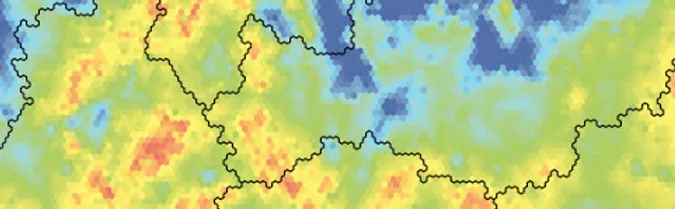
Viscovery’s roots go back to 1994, when Dr. Gerhard Kranner founded the company as a spin-off from a Vienna-based research center under the original name Eudaptics. From the start, the focus was on making complex data distributions accessible through self-organizing map (SOM) visualization and exploration—initially driven by industrial use cases such as process optimization and data-driven analysis of product quality.
This early technology work established the foundation for Viscovery’s core approach: combining SOM with multivariate statistics to make multivariate structures visible, interpretable, and practically actionable in real-world settings.
Growth and product build-out for customer analytics (late 1990s–2007)
In the late 1990s, the company entered a growth phase supported by external investors. This period was used to build a broader software platform and a professional sales and delivery organization. The Viscovery product line reached the market in 2002. In the following years, the commercial focus centered on customer behavior modeling, with projects around customer segmentation, retention, and response prediction and scoring—especially in telecom, finance, and retail.
Viscovery was developed into the Viscovery Data Mining Suite: a workflow-oriented project environment for applied analytics. It supported end-to-end projects—from data preparation and exploration to predictive modeling and operational deployment—within a structured, repeatable setup. Practical requirements from large-scale behavioral datasets and real-world deployment shaped both product and methodology.
Expansion into life sciences under Biomax (2007–2022)
In 2007, the company was acquired by Biomax Informatics AG (now part of LabVantage) and renamed Viscovery Software GmbH to align with the name of the product line. Over the following years, Viscovery broadened its customer base into life sciences and healthcare, carrying out numerous projects in clinical environments as well as in pharma and nutrition. Typical use cases included exploratory and predictive modeling of patient-related and clinical data, and investigations into drug effectiveness. At the end of 2021, Dr. Gerhard Kranner stepped down from his role as managing director, marking the end of the founder-led operating phase.
The product range was expanded with numerous features for exploratory data analysis, multivariate visualization, group profiling, and clustering. Viscovery continued to emphasize interpretability by combining SOM and multivariate statistics—a design well suited to domains where robust validation and practical integration into decision processes are critical.
Ownership change and cessation of operations (2023–2025)
In 2023, the company changed ownership again. While selected projects with existing customers continued, an adverse court decision led the owners to discontinue funding; operations ceased in 2025, followed by a formal winding-up.
During this period, parts of the Viscovery Suite were further developed with a focus on integration into third-party systems, reflecting the increasing importance of interoperability in modern analytics environments.
Founder-led acquisition of the assets and continuation (since 2026)
In early 2026, the founder acquired the complete Viscovery software estate, including the related IP and trademark rights, and continued the Viscovery business under the new Austrian company Viscovery Software e.U.
Since then, Viscovery Software e.U. has focused on maintaining and supporting existing installations, issuing new licenses, and carrying out selected consulting projects—supported by members of the former Viscovery team.
Development is ongoing. A new release (Viscovery 8.2) is planned for 2026, including a new density-based clustering method as part of the continued evolution of the platform, while preserving the core strengths of SOM-based visualization and multivariate-statistical rigor.
See who has already taken advantage of Viscovery.